The Elytron Bench
Viktor Grebennikov said the cavity lattice in a beetle's wing case pushes against gravity, and that he flew on a platform built from it. Nobody has reproduced it. This bench treats the claim the way a physicist should: write down exactly what was asserted, work out what known physics supplies at that scale, and design the smallest experiment that settles it. If his numbers are right, a one-square-centimeter coupon would register on a kitchen scale. That makes this one of the cheapest frontier claims there is to test. The last instrument is a design console: it supposes the effect is real and shows what the sweet spot of a platform would be.
—
The claim ledger: what was asserted, and what state each claim is in
Nathanael Bocker's General Construction Graph keeps five evidence states apart: predicted, observed, replicated, contradicted, refuted. Its source rule is the one that matters here: a source asserting something is not a measurement of it. Grebennikov's chapter in My World is a single author's account with no instrument records, and the widely circulated platform drawings come from a 2006 magazine reconstruction that calls itself a supposed design. The beetle optics are textbook. Both belong in the same ledger, in different rows.
| Claim | State | What is known | Test that moves it |
|---|---|---|---|
| Wing cases carry a regular cavity lattice | Replicated | Elytra are two chitin-protein laminates joined by pillar-like trabeculae around hemolymph cavities, with pore canals. Chrysina gloriosa has hexagonal surface cells about 10 µm across. The inner face carries regular fields of microtrichia used for wing locking. | Already measured. Tier 0 repeats it for the exact specimens used. |
| Raised wing cases add lift in flight | Replicated | Ordinary aerodynamics. The hindwings make the wake and the elytra reshape it; measured vertical force is higher with them than without, at some cost in efficiency (Johansson et al., 2012, on dung beetles). | Bocker's staged duct, instrument 08, is the engineering version. |
| The shell selects one handedness of light | Replicated | Scarabs, including the rose chafer Cetonia aurata, reflect left-circular light from a helicoidal (Bouligand) chitin stack. Michelson noted it in 1911; Sharma et al. traced the cell structure in Science in 2009. Cetonia is one of the two genera the reconstruction names. | Mueller-matrix polarimetry of every test article, as its structural fingerprint. |
| The flight wing carries rows of cones tipped with hairs | Source asserts | Dan A. Davidson, in his Shape Power talk, shows his own light micrographs of the underside of a beetle's inner (flight) wing at 100×, 430×, 970× and about 1,500×: staggered rows of bumps, each a hexagonal cell with one or two hairs rising from its center, the spike about 60 µm tall. He proposes that each pointed shape produces a magnetic field and that Grebennikov glued both wing covers and flight wings to his blinds. The anatomy fits microtrichia, the hair fields that cover beetle flight wings. No field or force measurement accompanies the images, and Grebennikov's own magnetometers read nothing. | Electron microscopy for the anatomy; a fluxgate magnetometer over a wing for the field; a printed array of 60 µm cones against a flat dummy for force. Preset in instrument 02. |
| A sealed vial with an insect in it jumped on the table | Replicated | The story Davidson opens with. In Grebennikov's text it is the cocoon of the wasp Bathyplectes anurus, about 3 mm long, leaping up to 5 cm. Jumping cocoons are a documented behavior with an ordinary cause: the larva inside flicks its body against the wall, most when warmed or lit. | None needed for lift. It is not evidence of a force from structure. |
| Cavity structures act on people and plants at 1 to 3 m (the "CSE") | Source asserts | Sensations of heat, pressure or tingling near bee nests and paper combs; slowed germination. Thermometers, magnetometers, electrometers and a radiometer showed nothing, by his own account. | Blinded sham exposure. Not the first test: the force claim is far more decisive. |
| A straw on a thread turns toward a comb | Source asserts | Indicator hung on a cobweb thread in a sealed jar with water in the bottom. Convection, static charge and humidity all move such a pendulum. | Same jar with a dummy comb, a thermal camera and a blinded researcher. |
| Two stacked chitin plates repel a small object | Source asserts | Summer 1988: two concave plates tied one above the other pushed a thumbtack aside. No force, mass or distance recorded. | Torsion pendulum or 0.1 mg balance, article against dummy. Instrument 05. |
| A platform of such plates lifts 100 kg | Source asserts | Chair-seat-sized board, standing rider, louvered panel blocks opened by a cable. Never demonstrated in public; no independent replication. | Coupon weight test. Instrument 03 gives the expected signal. |
| Four fans of nine plates, a high-voltage plate, a 9 V cell | Reconstruction | From A. V. Frolov's 2006 magazine article, which labels the design supposed. Useful as a geometry to copy, not as evidence. | None. It is a build hint. The high-voltage plate is also a warning: charged plates near a balance produce real forces. |
| Watches run wrong and calendars slip in flight | Internally contradicted | In any metric theory of gravity, Schwarzer's scaled metric included, a clock offset and an acceleration are the same field. Offsets large enough to upset a wristwatch imply accelerations of trillions of g. | Instrument 04. Measure force first; clocks only if force shows something. |
| The craft is invisible and fogs film | Source asserts | Observers said to see a sphere, disk or cloud. Two fogged rolls, a stuck shutter. | Out of scope until a force is established. |
The cell: what physics lives at the scale of an elytron
Two length scales define the structure. The helicoid pitch, a few hundred nanometers, is the distance over which the chitin fibers rotate through a full turn; it sets the color and the handedness. The cell size, microns to millimeters, is the cavity itself: the hexagons on the shell, the voids between trabeculae, or the paper comb Grebennikov built with six sheets each rotated 30° from the last, which is the same helicoid at a scale you can cut with scissors. Turn both and read what resonates there.
Why handedness matters to the test Chirality gives the experiment its cleanest control. A left-handed stack, a right-handed stack and a stack with no twist can be made from the same material at the same mass. If any anomaly depends on structure, it should differ across the three. If all three read the same, structure is not the cause.
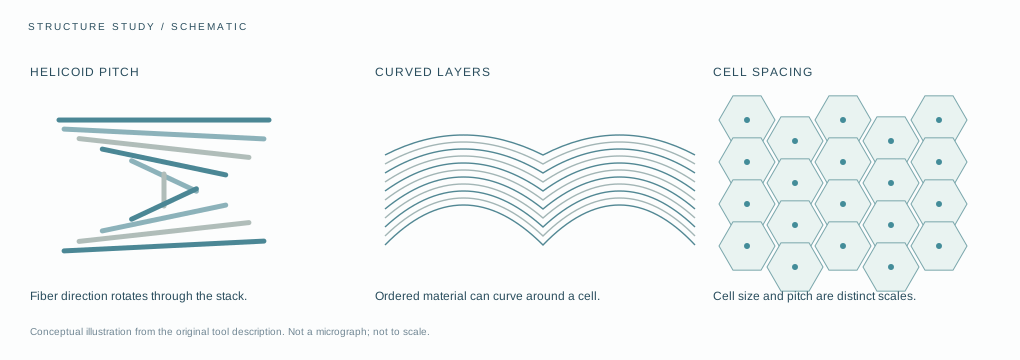
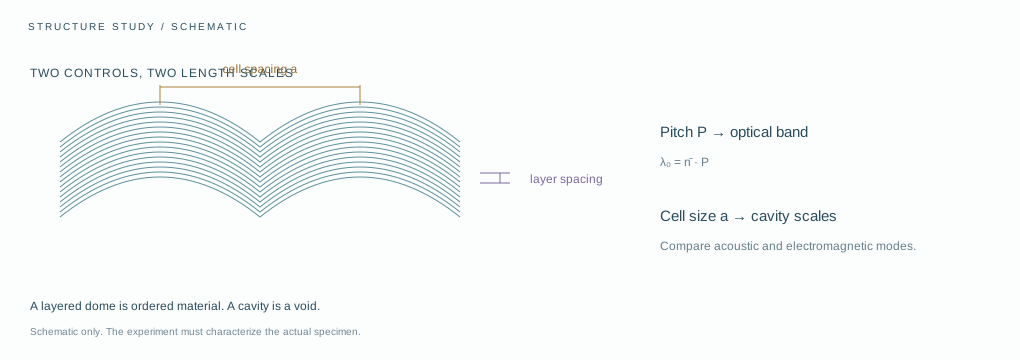
Three candidate structures Grebennikov never said exactly which pattern he meant. The candidates are the 10 µm color cells on the outside of the wing case, the inner face of the wing case that his own text names, and the hair-tipped cones about 60 µm tall that Dan A. Davidson reports on the underside of the flight wing. Tier 0 should image all three on the same specimen. The 60 µm preset shows what resonates at Davidson's size.
Left: fiber layers seen edge-on, drawn at 30° of rotation per layer. A fiber pointing along the page is a long dash; one pointing at you is a dot. Right: reflectance of the stack for each handedness across the visible band. The mean index is fixed at 1.56, typical for chitin with protein.
Meet the beetles
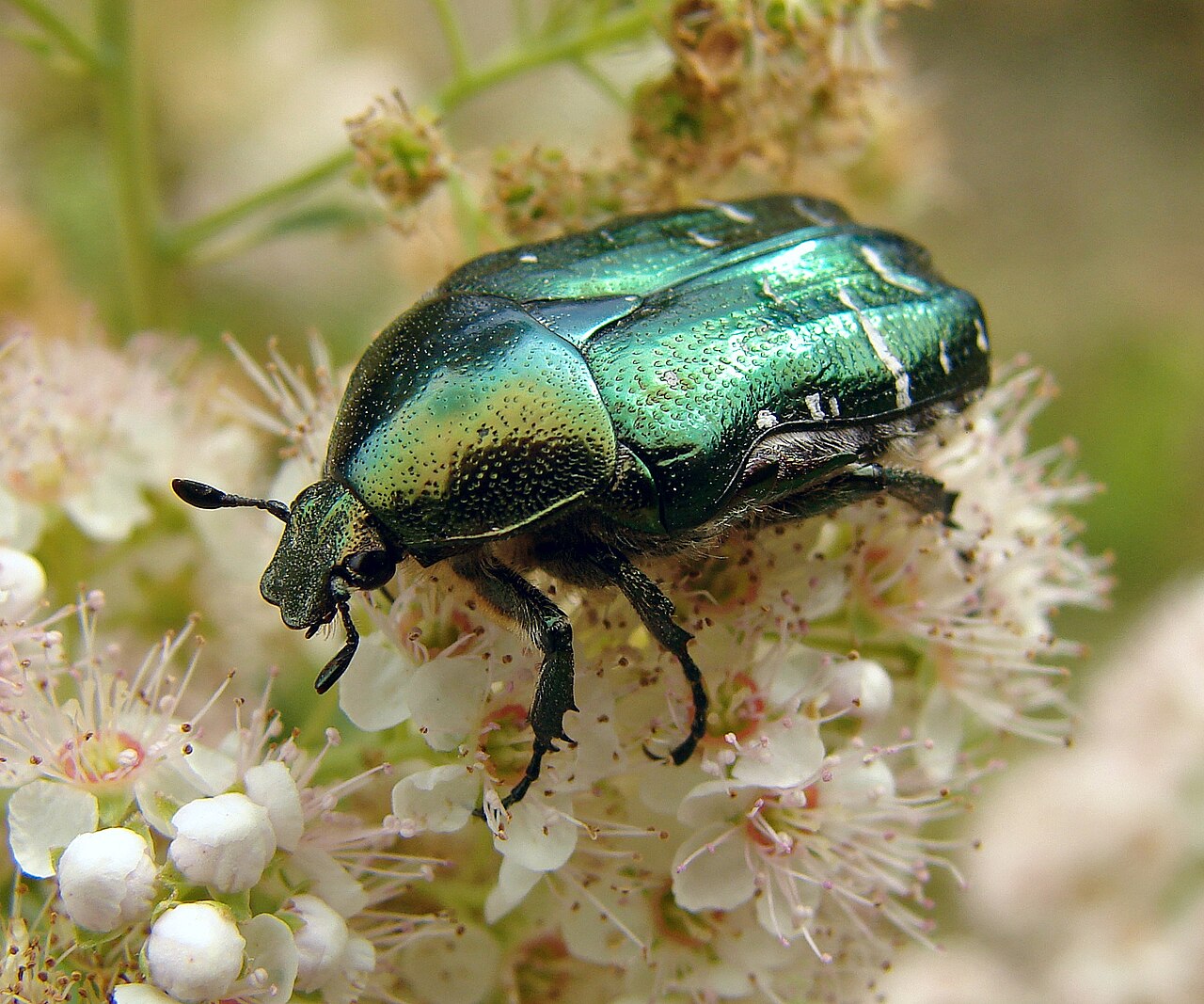
A living rose chafer on a flower, showing the metallic surface of the wing cases.
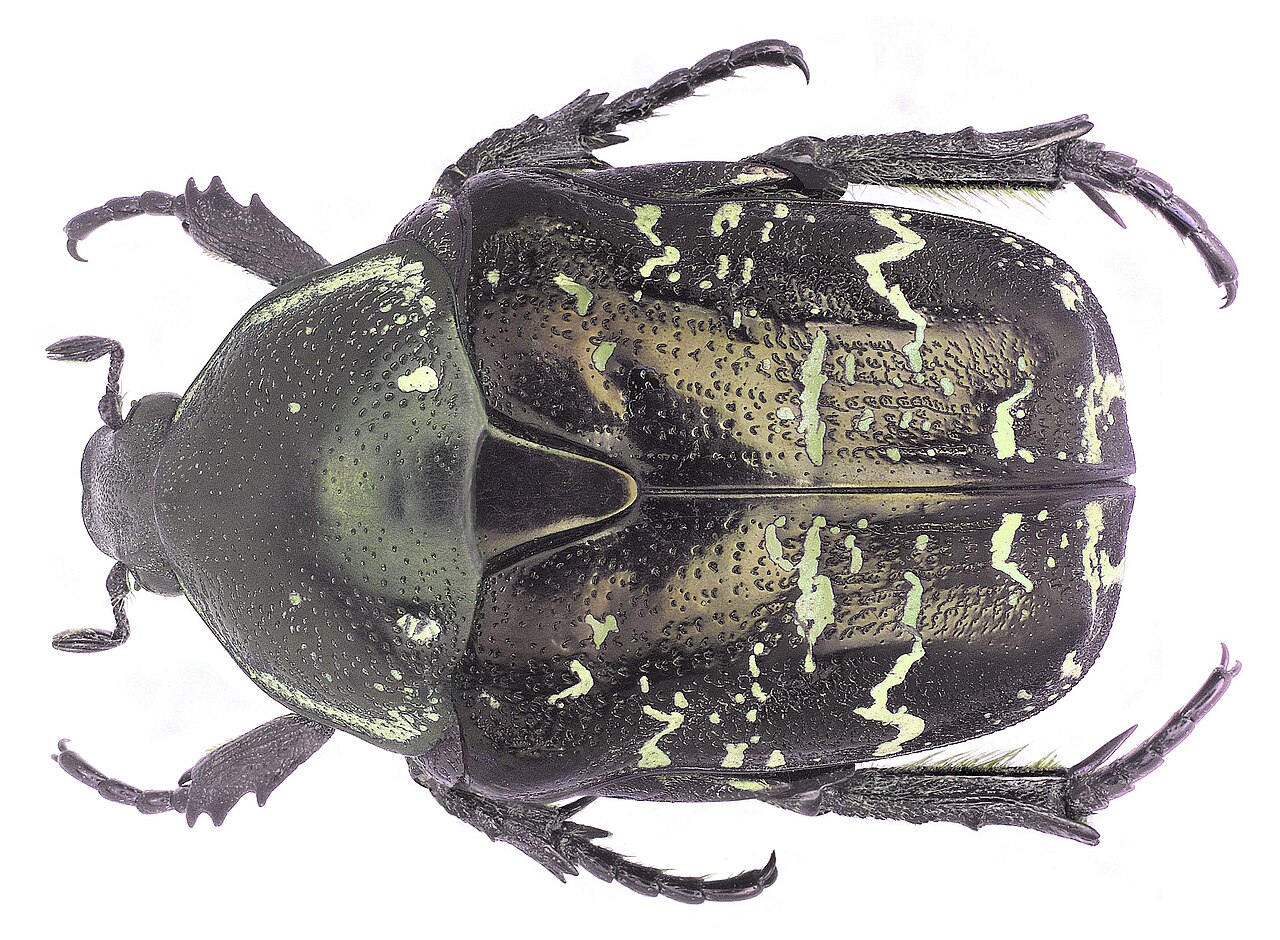
A detailed specimen view showing the pale markings, surface texture, and the two elytra.
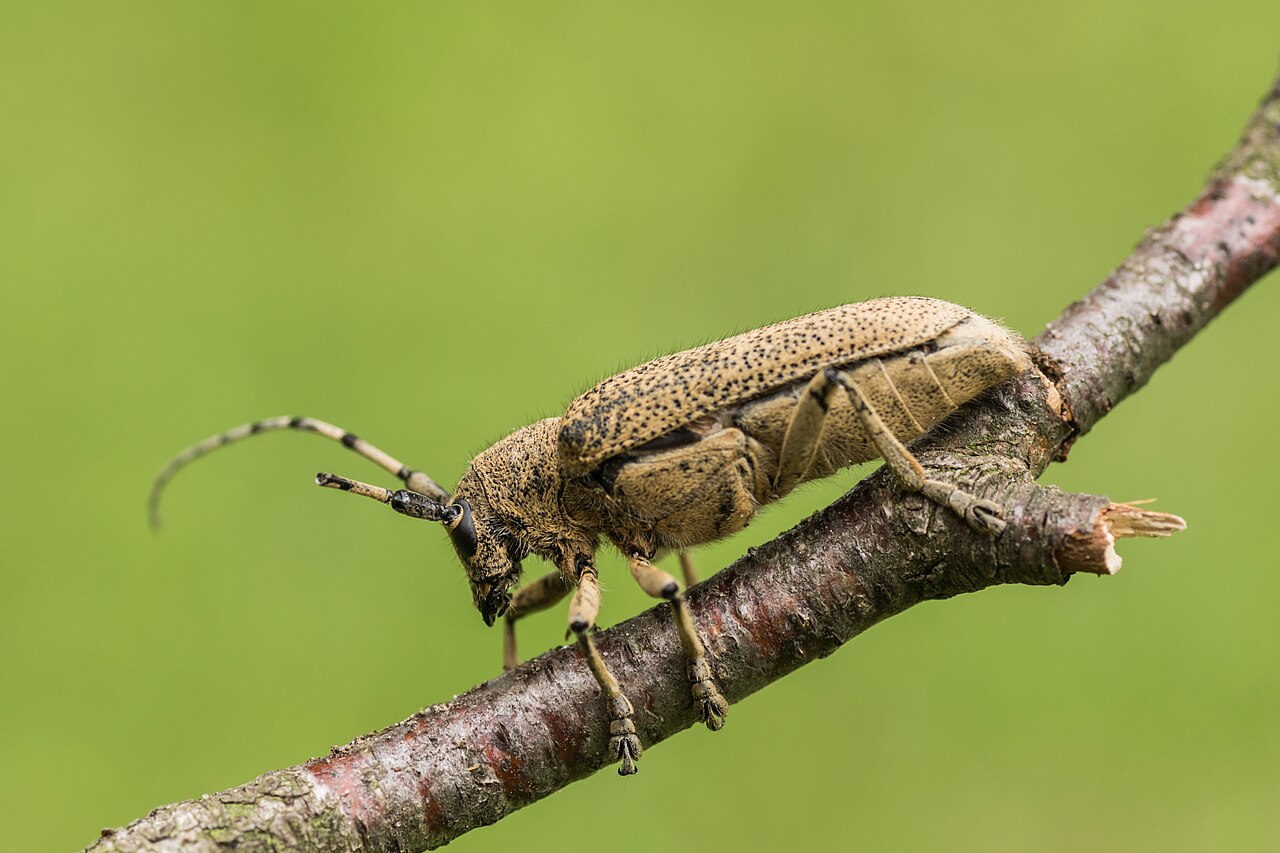
A longhorn beetle on a branch. Its closed wing cases provide a comparison with the scarabs.
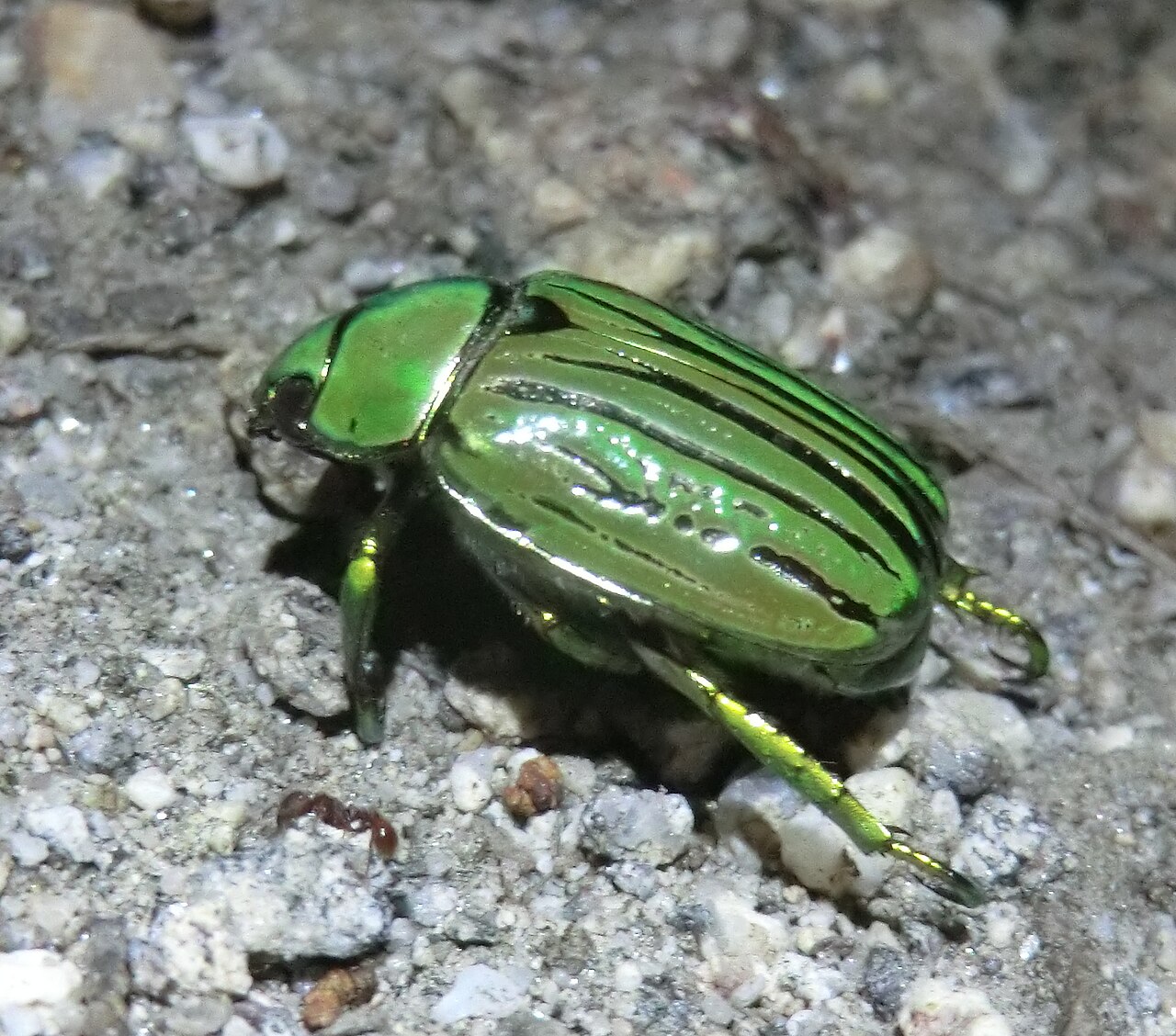
The green and silver wing cases of the species discussed in the cell-structure and optics study.
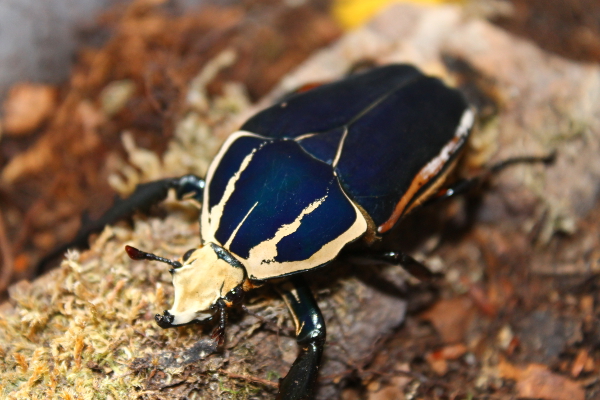
A blue male, showing the larger wing cases used as a reference in the species comparison.
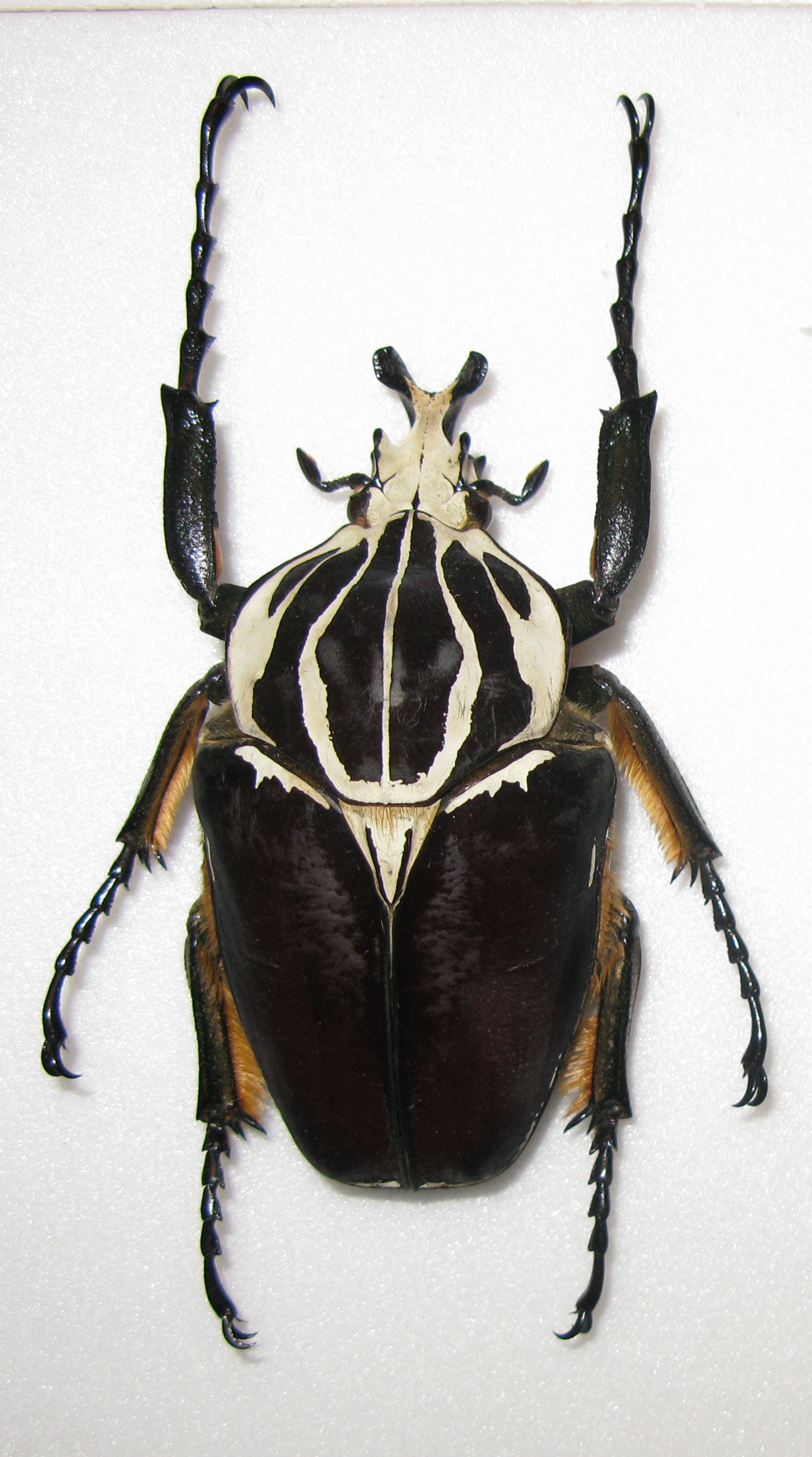
A full specimen view of the large beetle used at the upper end of the model’s wing-case comparison.
These photographs show real animals and specimens; they are not a common-scale comparison. Wing-case areas in the calculations remain the original model’s estimates and are not measured from these photographs. Photographers, original files, and licenses are linked beneath each image.
The lift budget: how big the claim is, and what a coupon would show
Lifting a rider on a board is a pressure. Divide weight by panel area and compare with every way known physics can push on a passive panel in air. Then shrink the panel to a coupon you can put on a balance. The claim does not say the effect needs a full platform, so a coupon carries the same pressure, and the force it should show is enormous by laboratory standards.
Bars are order-of-magnitude ceilings in room air. Casimir pressure uses the cell size from instrument 02 and acts between facing walls, so it cancels over a closed lattice. The ion-wind and acoustic figures are for driven systems, included because a charged plate or a vibrating panel near a balance will produce them whether or not anything new is happening.
03 · B The beetle count: how many wing cases per rider, if his numbers held
Grebennikov's only quantity is the platform itself: at least 100 kg of pull from a board of about the panel area set above. Taken at face value that fixes a lift per square centimeter of wing case, and from there the count is arithmetic. Each beetle supplies two elytra. Areas are estimates from typical body size, length × width × 0.8 per elytron; the area values are retained from the original model. The photographs in the specimen gallery are references and are not used to measure area.
—
Meet the six beetles in the photograph gallery → The area estimates above are retained from the original model.
Lift and clock: one field, two readings
Norbert Schwarzer's framework multiplies the metric by a scale factor, G = F·g, so lengths and durations rescale together by √F. That makes it a metric theory, and every metric theory ties two measurements to one number. If clocks at two places differ in rate by a fraction δ, anything between them is accelerated toward the slower clock. The Scaling Field Console reads a seam through its clock ratio; this dial reads the same relation as a force.
Reduction, to be checked This is the weak-field, static reading of the scaled metric, and the step from F to a force is this page's, not a quotation from Fluid Universe. Dr. Schwarzer should confirm or correct it. The conclusion does not depend on the details: it holds for any theory that respects the equivalence principle.
The diagonal is the relation above for the chosen extent. The horizontal band is one g, the lift the platform needs. Vertical ticks mark what real clocks resolve. The two claims sit thirteen or more decades apart on the same line, so they cannot both come from one field. The practical rule: a balance sees a gravity-scale effect at one part in a million with ease, while only an optical lattice clock can see it at all in time. Weigh first.
The blind bench: louvers, a dummy, and a record you can trust
Grebennikov's control was a louver: panel blocks slid together to lift and apart to land. That is a gift to the experimenter, because an effect that can be switched can be modulated, and a modulated effect can be pulled out of drift. The bench below simulates the real experiment. Two identical balances sit side by side, one under the test article and one under a dummy of the same mass and outline with no cavities. A motor opens and closes both louvers on a random schedule the researcher cannot see. The analysis is fixed in advance.
Dr. Charles Jorgensen's contribution is the second reading. Averages can hide a short or intermittent response; a recurrence plot of the same record shows it as texture. A response that follows the louver appears as a checkerboard, and determinism rises above what shuffled copies of the record give.
The injected effect is a fraction of the coupon force from instrument 03; the noise is a multiple of that instrument's balance resolution. Turn the dummy off with the artifact on and the bench reports a detection that is not there: heat from the motor and air moved by the louver load the pan in step with the schedule. That is the single most likely way to fool yourself in this experiment. Export a real record to the Unfolding Bench for the full embedding analysis.
The build ladder: from wing case to verdict
Bocker's graph runs backward from function to feedstock and refuses to promote a route until every gate passes. Applied here, the function is modest on purpose: a force on a coupon that tracks cavity geometry. Nothing is ridden, and nothing is scaled up, until that exists in two laboratories.
Construction route for the test article
Tiers, cheapest first
- Tier 0, characterize. Electron microscopy of both faces of the elytra, micro-CT of the cavities, circular polarimetry. Output: a geometry file and a fingerprint for every article.
- Tier 1, two plates on a balance. Repeat the 1988 observation with a 0.1 mg balance in a draft shield, then under vacuum. A week of work.
- Tier 2, the structure matrix. Three cell scales, three handednesses, layer counts of 1, 2, 4, 8 and 16, plus one printed array of 60 µm cones after Davidson. Schwarzer's coherent-domain picture predicts an onset with a threshold; a classical artifact scales with mass or area.
- Tier 3, the louver. Instrument 05 in hardware: twin balances, motorized blinds, random schedule, analysis registered beforehand.
- Tier 4, clocks. Only if Tier 1 to 3 show a force. Two disciplined oscillators, one inside the field.
- Tier 5, a second laboratory. Ship the articles and the protocol. Until this passes, the state stays at observed.
Controls that decide whether a signal is real
- Moisture. Chitin takes up water from the air, percent by mass. On a 0.1 mg balance that swamps everything. Condition articles and dummy together; log humidity.
- Buoyancy and convection. A cavity panel has a different volume and warms differently. Run in vacuum or inside an isothermal shield.
- Static charge. Dry chitin and paper hold charge. Ground the fixtures, use an ionizer, enclose the pan in a Faraday shield. No high voltage anywhere near the balance.
- Magnetism and vibration. Non-magnetic hardware; motor on a separate mount.
- The experimenter. Coded articles, a schedule generated by machine, and the code broken after the analysis is frozen.
What counts as an answer
Refuted at coupon scale if article minus dummy stays below one part in a million of the claimed force across all three analog classes, and a second laboratory finds the same. That is seven tests and a few thousand dollars of equipment.
Promoted to observed only if a difference survives vacuum, reverses when the article is inverted, scales with area, depends on handedness or layer count, and passes the sign-flip test at 0.01 in a registered run. One anomaly is neither a discovery nor a refutation.
What a null leaves standing. The beetle remains worth building: a light, tough, self-assembled laminate that sorts light by handedness from shell waste. That route is already admissible in Bocker's graph, and it is a product whether or not anything floats.
The platform console: what a sweet spot would look like
Instruments 01 to 06 ask whether the effect exists. This one supposes it does and asks what a good platform would look like. It pins a lift law to his one number, 100 kg on a quarter of a square meter, and lets layer count, twist, cell size, build tolerance, humidity and louver opening trade against each other. Slide the dials and the platform lifts or sits. The sweet-spot button finds the design that carries your rider with 30 % of the louver in reserve.
Reading the law pmax is set so that his design, four fans of nine plates carrying the six-sheet, 30° stack he described, lifts his 100 kg under the default assumptions. Everything after it is an efficiency between 0 and 1: T is how completely the twisted stack closes on itself, S is a threshold in layer count after Schwarzer's coherent-domain onset, C is how well the cell matches a target size, and r is the fraction of cells locked in step, from the coupled-oscillator model Jorgensen builds on. θ is the louver, the throttle.
Where the efficiency goes
Left: the platform in elevation. Green arrows are lift, the dark arrow is weight; the board climbs when lift wins. Right: the board from below, four fans of plates swung out by the louver cable. Plate color deepens with overall efficiency. A fan that is fully folded exposes one plate and lifts almost nothing, which is how he described landing.
The sweet-spot map: layers against twist
More layers cost more wing cases, so the quantity to maximize is lift per wing case, T·S/N. The map shows it for every layer count and twist angle under the current assumptions. The bright ridges are a piece of real geometry: a twisted stack balances in-plane, with no preferred direction left over, exactly when it closes a half turn, N·φ = 180°, 360° and so on. Two layers at 90° is the cross-ply of ground beetles. Six layers at 30° is the paper comb Grebennikov described. Twelve at 30° is one full pitch of a scarab's helicoid.
Move the amber layer onset dial and watch the best column shift. That dial is the largest unknown in the model. Tier 2 of the build ladder, the layer series 1, 2, 4, 8, 16, is the experiment that would measure it.
Columns are layer counts 1 to 12; rows are twist per layer from 0° at the bottom to 90° at the top. The ring is the current design; the gold diamond is the best cell on the map. Dashed curves trace N·φ = 180° and 360°.
Prototype schematic: one fan on a twin balance
The prototype is one fan, not a platform. It is the smallest article that contains everything the claim depends on: a twisted stack of cell lattice, plates that overlap, and a louver that opens and closes. It sits on a balance beside a dummy of the same mass and outline. The drawing follows the dials in instrument 07, so pressing the sweet-spot button redraws the stack, the plates and the dimensions for that design.
Scope A bench article for weighing. The model's lift for one fan is far more than the fan weighs, so if the effect exists the balance reading collapses toward zero the first time the louver opens. Nothing here is built to be stood on, and nothing carries high voltage.
| No. | Part | Specification | Why |
|---|---|---|---|
| 1 | Lattice film | — | The structure under test. Left-handed, right-handed and untwisted versions from the same material. |
| 2 | Carrier plate | — | Follows the reconstruction's sheet-metal plates. Grounded so it cannot hold charge. |
| 3 | Axle and hub | Brass or titanium pin, 3 mm, with a stacked hub so plates fan evenly. No steel. | Keeps magnetic forces out of the reading. |
| 4 | Louver drive | Micro servo, coin cell and infrared receiver riding on the pan. Powered down before each reading. | No wire or cable crosses to the pan, so nothing off the balance can push on it. |
| 5 | Dummy fan | Same plates, same drive, same mass to 1 mg. Film cast flat with no cells and no twist. | Carries every artifact the article carries, and nothing else. |
| 6 | Two analytical balances | 220 g capacity, 0.1 mg readability, serial output, read together once a second. | Article minus dummy removes drift, air and heat common to both. |
| 7 | Shield | Grounded copper mesh inside a closed acrylic draft enclosure. Ionizer bar run before each session. | Stops air currents and static, the two usual causes of a false reading. |
| 8 | Sensors | Four thermistors, humidity, pressure, an electrometer plate and an accelerometer on the slab. | Lets every excursion in the record be checked against an ordinary cause. |
| 9 | Logger and scheduler | Single-board computer. Draws the open and closed schedule at random, fires the infrared trigger, logs everything, keeps the schedule sealed until the analysis is frozen. | The researcher cannot know the louver state. |
| 10 | Slab | Granite surface plate, 60 × 45 cm, on damping feet. | Vibration and tilt. |
| 11 | Vacuum stage (second build) | Bell jar below 1 mbar with a torsion pendulum or vacuum-rated load cells in place of the balances. | Removes buoyancy and convection altogether. Built only if the first stage shows a difference. |
First-stage parts are standard laboratory items; two balances are most of the cost, on the order of a few thousand dollars each. The lattice film is the long-lead item: self-assembled cellulose films can be made in a week, two-photon printed lattices at 10 µm cells take a print service or a university facility.
What each dial stands on
| Dial | Status | What is real | What is assumed |
|---|---|---|---|
| Calibration | Claimed | Nothing measured. The figure is 100 kg on a board "slightly larger than a chair seat", with the plate layout from the 2006 reconstruction. | That the account is accurate, and that his plates carried the six-layer, 30° stack he used in his paper combs. The model is pinned to that one point. |
| Louver opening | Claimed | His description: panel blocks joined to lift, parted to land, worked by a cable from the left handle. | Lift proportional to exposed plate area. |
| Twist and closure | Geometry | A stack of fiber layers is balanced in-plane when its twist closes a half turn. Beetle cuticle uses exactly these stacks: cross-ply and helicoid. | That lift follows closure. A testable alternative: lift follows handedness instead, which the left, right and untwisted articles separate. |
| Layer onset | Assumed | Schwarzer's framework gives sigmoid onsets for coherent domains. His 1988 observation used two plates, not one. | The threshold itself, N₀, and its sharpness. Free parameters. |
| Cell size | Assumed | Scarab cells are about 10 µm. A 5 µm cell has its lowest electromagnetic mode at the peak of room-temperature thermal radiation. | That this coincidence matters for lift. Set the amber dial elsewhere to drop it. |
| Cells in step | Mathematics | Coupled oscillators lock only when their frequency spread is below about 0.63 of the coupling (Kuramoto). Printed and grown lattices have real size spreads. | That lift needs the cells locked, and the coupling strength. |
| Humidity | Claimed | Chitin and cellulose films swell with moisture and their pitch shifts; some beetles change color with humidity. | That swelling breaks the lock above 50 % humidity. Chosen to reproduce his remark that flying was impossible in rain. |
| Weights and areas | Estimated | Board and post 8 kg; 0.5 mm aluminum plates; elytra near 10 mg per cm²; wing-case areas from typical body sizes. | Nothing beyond rounding. |
What a sweet spot means here
Under these assumptions a good design has three properties. Its stack closes: layers times twist is a multiple of 180°. It has just enough layers to pass the onset, and no more, because every extra layer is paid for in wing cases. And its cells are uniform enough to lock, which favors a printed lattice over collected elytra and dry air over damp.
Those are three predictions. Each one maps to a row of the structure matrix in Tier 2, and each one can fail on its own.
What this console cannot tell you
Whether anything lifts. A model calibrated to one account will always reproduce that account. If the coupon test in instrument 03 reads zero, every curve on this page is zero with it, and the design study ends there. Nobody should stand on a platform, and nothing should carry high voltage, on the strength of this page.
The field-transform duct: Bocker's reading of the platform
Nathanael Bocker's analysis sets the cavity effect aside and asks a different question. Treat the air as a field, S = [p, ρ, u, ω], and treat every part of the machine as an operator on that field. A first rotor makes a wake. A second stage is chosen to repair that wake, removing swirl the first one wasted. Later stages condition and even out the flow. The fan-shaped slats under the board stop being lift generators and become the boundary the flow leaves through. The beetle is his example: the hindwing makes the field, and the raised wing case reshapes it.
A second hypothesis, in ordinary physics This is a powered machine that moves air. It needs no new effect, so it can be built and measured now, and it comes with a hard floor: for a given thrust and exit area, no arrangement of stages can use less power than the ideal figure above. Everything the stages do is recover losses above that floor. The console shows how much there is to recover, which is exactly Bocker's test for each stage: improvement in the flow per watt it consumes.
Top: the operator chain, with the state after each stage. Bottom: the power bill. Green is the ideal jet; the other segments are what the later stages exist to shrink, plus what they cost. Unevenness enters as the spread of exit velocity over its mean: thrust goes with the mean of v², power with the mean of v³, so a lumpy jet costs more for the same lift.
What the numbers say
Area and power dominate. A 95 kg load on a board-sized 0.25 m² disk needs tens of kilowatts and a jet near 200 km/h, whatever the stages do. The same load on 2 kW needs a disk of roughly a hundred square meters, which is why human-powered helicopters are the size of a gymnasium. A 9 V cell supplies about half a watt.
Conditioning is worth tens of percent, not multiples. Recovering swirl and evening the jet typically returns 5 to 20 % of shaft power. That is real money in an aircraft and it is the whole case for contra-rotating fans and stator vanes. It cannot close a gap of a thousandfold.
The beetle agrees, with a cost. Raised wing cases do add vertical force in the species measured, and wind-tunnel work on dung beetles found they do it while lowering aerodynamic efficiency. The second structure transforms the field, as Bocker says. In the animal that transformation is not free.
His experiment, as a protocol
- Transparent duct, one stage. Measure axial and tangential velocity, pressure and turbulence across the exit plane. That is S1.
- Add one stage at a time. Re-measure after each. Score it by thrust per watt gained over watts it draws. Remove any stage that scores below one.
- Try passive first. Stator vanes, a honeycomb straightener, a slatted exit. If a passive surface does the job of a driven stage, keep the surface. A cell lattice from instrument 02 is a legitimate candidate straightener.
- Harmonic against detuned. Run two stages at an exact 2:1 speed ratio, then at a ratio a few percent off. Compare thrust per watt, tonal noise and vibration. This is his quasi-periodic hypothesis, and it needs only two speed controllers and a microphone.
- Once per cycle. Sample the field at the same phase each revolution. A steady pattern is his fixed point; a drifting one is where Jorgensen's recurrence plot earns its place again.
Four exercises for students
Grebennikov's board is about 0.25 m² and carries 100 kg. What force should a 1 cm² coupon of the same material show, and how does it compare with the 0.1 mg resolution of a teaching-lab balance?
Answer
Pressure is 981 N over 0.25 m², about 3.9 kPa. On 1 cm² that is 0.39 N, the weight of 40 g. A 0.1 mg balance resolves about 1 µN, so the claimed signal is some 400,000 times the resolution. A clean null bounds the effect below a few parts per million of the claim.
A cellulose film reflects left-circular light at 620 nm. Its mean index is 1.56. What is the helicoid pitch, and what does a right-circular analyzer show?
Answer
P = λ/n̄ = 397 nm. Through a right-circular analyzer the band disappears and the film looks dark or shows only its substrate, which is the test Michelson's successors used on scarabs.
Suppose a wristwatch inside the platform's field ran 10 seconds per day wrong, and the field extends 1 m. What acceleration does the same field imply?
Answer
δ = 10/86,400 = 1.2 × 10⁻⁴. Then a = c²δ/L ≈ 1.0 × 10¹³ m/s², about a trillion g. A field gentle enough to carry a person shifts clocks by 10⁻¹⁶ per meter, which no watch can show. The reports are incompatible with each other unless the watch was disturbed by something ordinary, such as vibration or a magnet.
On instrument 05, set the effect to zero, leave the artifact on and switch the dummy off. Run it five times. Then switch the dummy on. What changed, and what does that tell you about every single-balance report in the literature?
Answer
Without the dummy the bench detects an effect every time, at a tiny p-value, because the artifact follows the louver exactly as a real effect would. With the dummy subtracted the difference returns to zero. A statistical test certifies that something follows the schedule; only the control says what.