Dr. Norbert Schwarzer’s scaled-metric framework, most recently in Fluid Universe (Jenny Stanford Publishing, 2026), applied to my Three-Orb paper — with the papers, an interactive console and a hardware design study. An exercise, not a finding.
I have spent a lot of time with theories of everything. Some are elegant, a few are brilliant, and most of them share a habit that frustrates me: they stop at the equations. There is rarely a worked example, rarely a current technology the theory speaks to, rarely a derivation a peer can check line by line, and almost never an exercise a student can pick up, change a number in, and watch what happens. A theory nobody can play with is hard to test, and a theory nobody can test can be neither trusted nor ruled out.
This is my attempt to do it differently, and it is the first of what I intend to be a series.
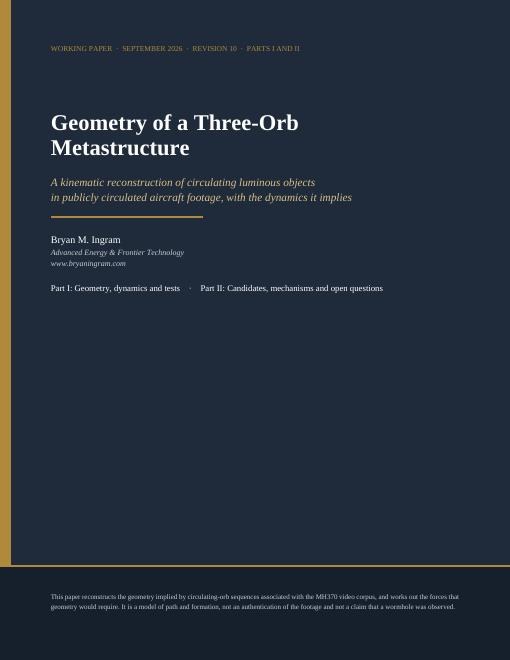
The test case is my own working paper, Geometry of a Three-Orb Metastructure (Revision 10.1). It is a kinematic reconstruction of some widely shared footage that appears to show three luminous spheres circling an airliner, and it is published together with the evidence that the footage is a visual-effects composite; the paper asks what the spheres would have to be doing if the footage were real, and says what would settle the question. The framework applied to it is Dr. Norbert Schwarzer’s scaled-metric formulation, developed across his books and most recently in Fluid Universe (Jenny Stanford Publishing, 2026). Norbert reviewed an earlier revision of the paper, and his comments on dimensionality and scale are what prompted this exercise. He has not reviewed the supplement, the guide or the console, and any error in reducing his framework to the five postulates I work from is mine.
The method is deliberately strict: adopt the postulates as if they were true, re-derive the original paper under them, and write down both what the framework would buy and what it would cost.
The release has four parts.
What this is not. It is not a claim that the framework is right, that the footage is real, or that anything here has been demonstrated. The hardware is a design for critique, not an apparatus that tests the theory, and nothing reports a measurement taken with it. The exercise states its own costs: the scale dependence it needs must stay hidden below about a hundredth of a millimetre, where the Casimir law is measured to about a percent; it pulls two ways on the dimension number; and it replaces one unknown with four.
What this is. An invitation. The exercise ends in four measurements on which this framework and the textbook give different answers, and each can be made with instruments that already exist: frame-by-frame tracking of the existing footage, a spectrograph on a luminous plasma, a microwave plasma chamber, and a torsion balance. If you are a physicist, check the mathematics and tell me where it breaks. If you are a student, open the console and push it until it fails, and send me what you find. If the answers come out the textbook’s way, a door closes, and that is worth knowing too.
— Bryan M. Ingram
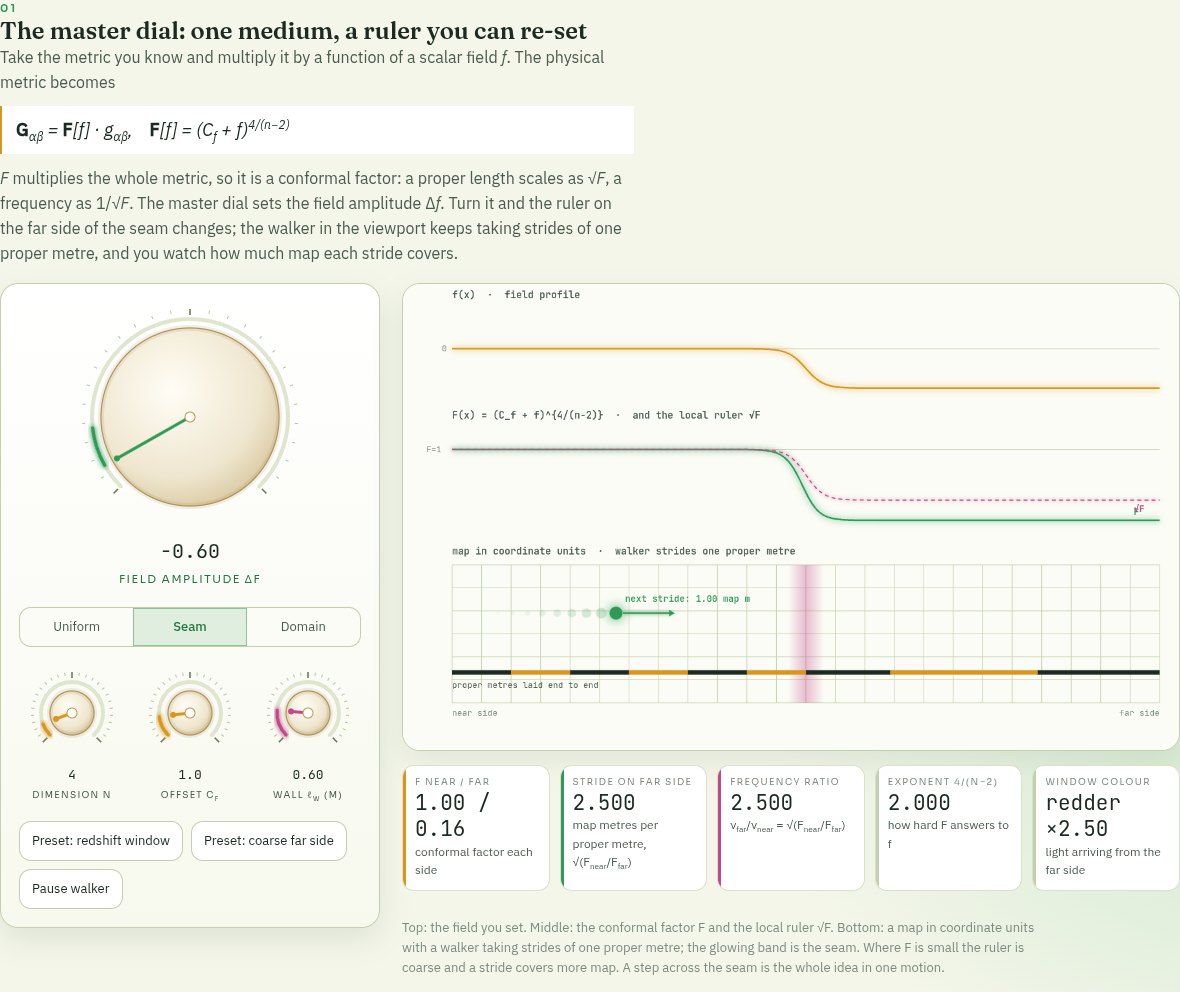
Built for physics students who learned relativity the usual way and want to know what changes when the ruler itself becomes a field. Six instruments — the master dial, the seam navigator, the reference instrument (a design study), the dimension dial, the scale test and the collapse bench — plus a problem set with worked answers. Every reading is computed live from the formulas shown, and each instrument marks where it simplifies.
The framework is Schwarzer’s; the reduction to these instruments is the supplement’s. The instruments are for building intuition, not for citing.
Open the console → Problem set
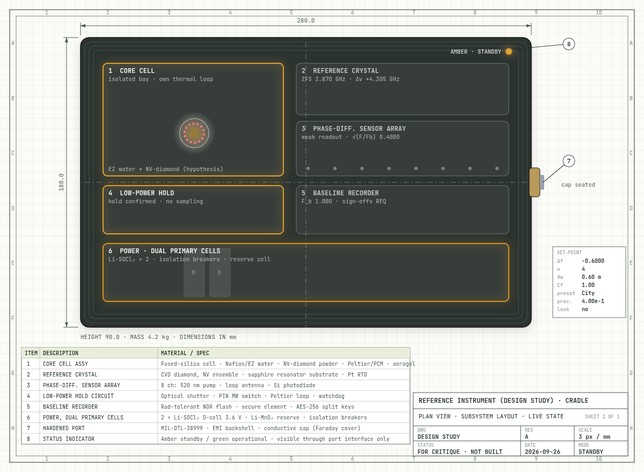
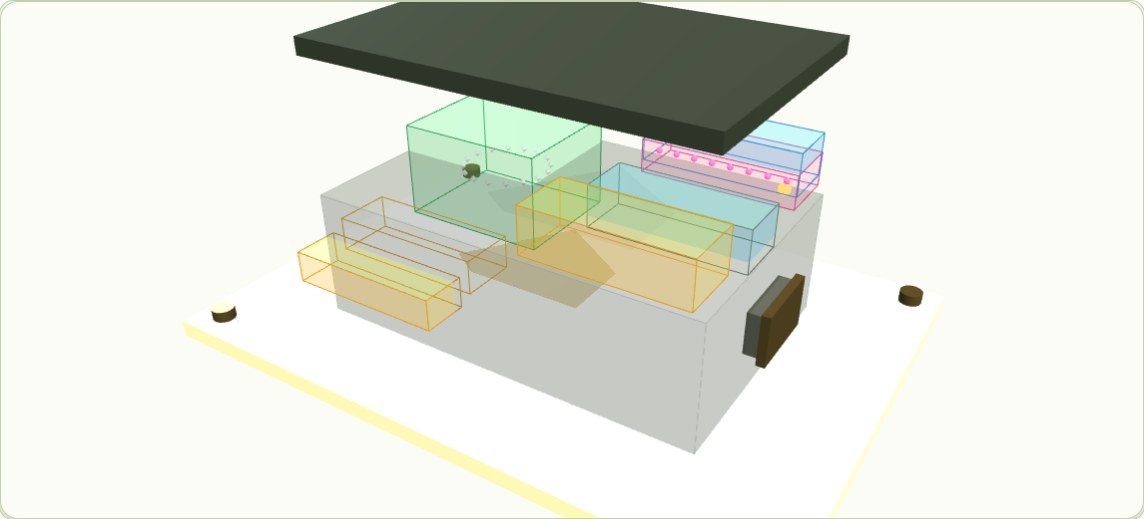
The dials in the console set the state a seam would need. This is a reference instrument drawn as it would have to be if the framework were right: a sealed measuring package on a cradle that carries the same dials, kept in step both ways. It does not check the theory; it presupposes it, and it is drawn so that the assumptions can be criticised as engineering rather than as prose. Its reference crystal is read as a nitrogen-vacancy diamond, whose zero-field line near 2.870 GHz would shift with the scale factor: a bench magnetometer’s job at one scale, an atomic clock’s at another.
The console shows the plan view, a live 3D model and a materials and mass budget, and says plainly where the design is an engineering fill-in. The checks on the framework are the four measurements below, and they use instruments that already exist.
Explore the design study →None requires believing either reading. These are four measurements a lab could make with existing instruments: frame-by-frame tracking of the existing footage, a spectrograph on a luminous plasma, a microwave plasma chamber, and a torsion balance.
What the three-orb papers would mean if Norbert Schwarzer’s idea of space is right — explained in everyday words. Space as a medium, a “seam” as a place where the ruler changes, what crossing one would take, what would have to be true, and the four measurements that would settle it. Opens with the note above.
Download ↓ Read onlineAdopts five postulates I distilled from Schwarzer’s scaled-metric framework, as set out in Fluid Universe, for the length of the document and re-derives Geometry of a Three-Orb Metastructure under them — an exercise, not a finding. It records what the framework would buy (a named binding force, residence instead of stability, boundary radiation, a domain-wall portal) and what it would cost, and ends in four observations that separate it from the standard reading.
Download ↓ Read onlineThe original analysis: a kinematic reconstruction of the circulating luminous objects in the publicly circulated video corpus, treating them as real point masses and writing down the simplest geometry and dynamics that fit — and the measurements that would settle the matter. It is published together with the evidence that the footage is a visual-effects composite.
Download ↓ Read online Part I Part IIBy Norbert Schwarzer (Jenny Stanford Publishing, 2026), ISBN 978-981-5352-15-3. The most recent of the books in which Dr. Schwarzer develops the scaled-metric framework this analysis adopts — the scaled metric, explicit dimensionality, coherent domains and the “ever-jittering fulcrum.” Read it at the source; my reduction of it to five postulates, and any error in that reduction, is mine.
About the author. Dr. Norbert Schwarzer graduated in physics from the University of Chemnitz, Germany, in 1991, earned a PhD in contact mechanics there in 1998 and completed his habilitation in 2004. After research projects abroad, he became an assistant professor at Chemnitz in 1999, and in 2005 he founded the Saxonian Institute of Surface Mechanics (SIO). He has published papers on contact-mechanical approaches for laminates, composites and layered materials, and later applied concepts from theoretical physics to fields such as materials science and socioeconomic modelling, work that led to refinements of the theory itself. His books with Jenny Stanford Publishing include The Theory of Everything: Quantum and Relativity is everywhere – A Fermat Universe (2020) and Fluid Universe (2026).
Get the book →Corrections, counter-derivations, console bugs, measurements and better exercises are all welcome. If you use the console in a class, I would love to hear how it went.
Send a critique →