Explore a model.
Inspect its assumptions.
This lab explores Theory of Everything (TOE) ideas — the goal of a single framework for the fundamental forces and matter — with browser-based tools for fields, time series, structure, and experimental design. Begin with an example, change one thing, and look at what the model actually says. The work is exploratory; it is not a proof of unification.
After Jorgensen: instruments you can run
The recurrence and oscillator methods behind these two instruments come from working drafts by Dr. Charles Jorgensen, former Chief Neuro Scientist at NASA Ames — drafts released publicly for the first time in the Research volume Listening to Living Signals. Jorgensen has reviewed and approved these interactive pieces. Here the lab’s job is narrow: let you run the documented analysis recipes yourself, change a parameter, and see where an assumption breaks. Any error in applying his methods to a seam is mine. Like everything on this page, they are an exercise, not a finding.
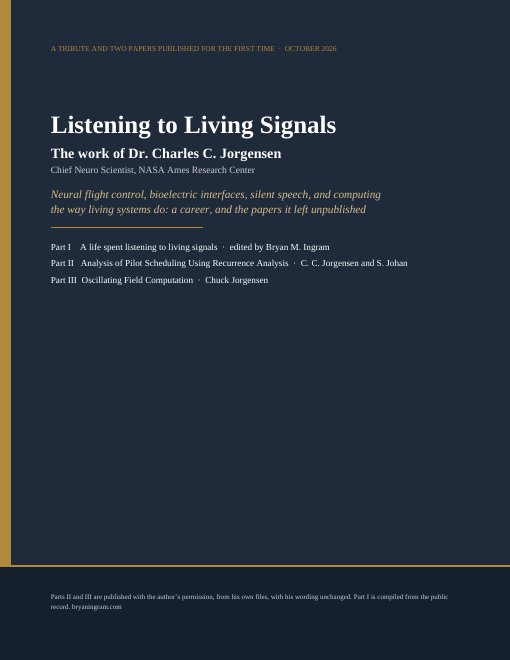
Listening to Living Signals
The 41-page Research volume gathers a public-record tribute with the first public release of those two Ames drafts. Downloads and the fuller context live in the Research library; this strip only points you at the runnable instruments.
Open on Research → Companion papersA question you can work with.
Field Dial↗
An introductory view of scale, rulers, and clocks.
Unfolding Bench↗
Explore delay embedding and recurrence, or bring a time series.
Field Console↗
Go deeper into constraints, equations, and computed route reports.
 04 / Structure & testing
Elytron Bench↗
Meet six beetles, examine the evidence, and design a test. Includes the platform study.
Set-Point Cradle↗
Inspect a proposed instrument, its interlocks, and simulated readiness checks.
Beetle photo: Chrumps · CC BY-SA 3.0.

Models are not measurements. The instruments distinguish analysis methods, conditional physical models, and hardware hypotheses. Calculated outputs should be read with the assumptions shown inside each tool.
Make the reasoning
available for critique.
A useful instrument lets someone change a parameter, inspect an equation, and find a limitation. The lab is an invitation to do that work in the open.