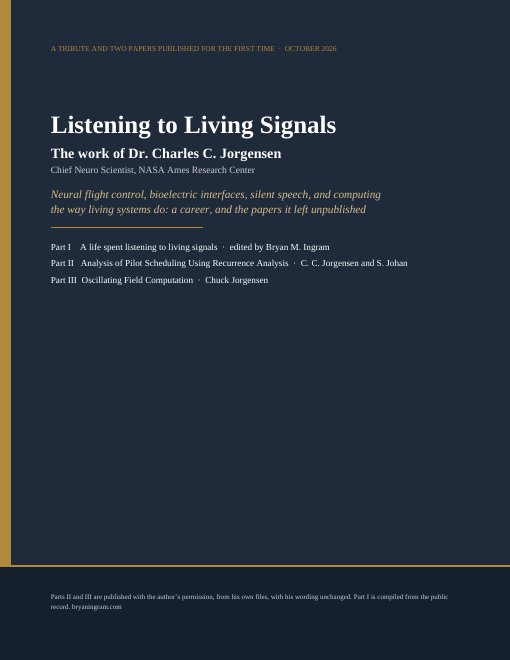
Listening to Living Signals: The work of Dr. Charles Jorgensen
A tribute and two papers published for the first time. Part I tells the story of his career, drawn from the public record. Parts II and III publish, with his permission and his wording unchanged, his pilot-heart-rhythm recurrence analysis (with S. Johan) and his design for computing with oscillating fields. 41 pages.
Download ↓ Read onlineRoute reports, one PDF per route
Choose a route, from Los Angeles to Tokyo or from Earth to Mars, and the console works it through every instrument and writes a short downloadable report: what the line element fixes, what depends on the unknown n, and which checks are ready. The “same physics” checks have been tested only up to a ratio of 4, far below any route, so each report marks them untested. An exercise, not a finding, and open for peer review.
Generate a report → Release timelineHow this work has unfolded
Each piece built on the one before it, and each is still open to correction. Here are the main steps so far.
- Open TOE Lab, Analysis No. 1
- The Unfolding Bench and its library
- Listening to Living Signals
- Companion papers after Jorgensen
- Rev 10.3, with Schwarzer’s correction
- Console update
- Route reports
A theory you can turn the dials on
Dr. Norbert Schwarzer’s scaled-metric framework, most recently in Fluid Universe (Jenny Stanford Publishing, 2026), applied to the Three-Orb paper — a technical supplement, a plain-language guide, an interactive console for physicists and students, and a hardware design study. An exercise, not a finding.
Enter the lab →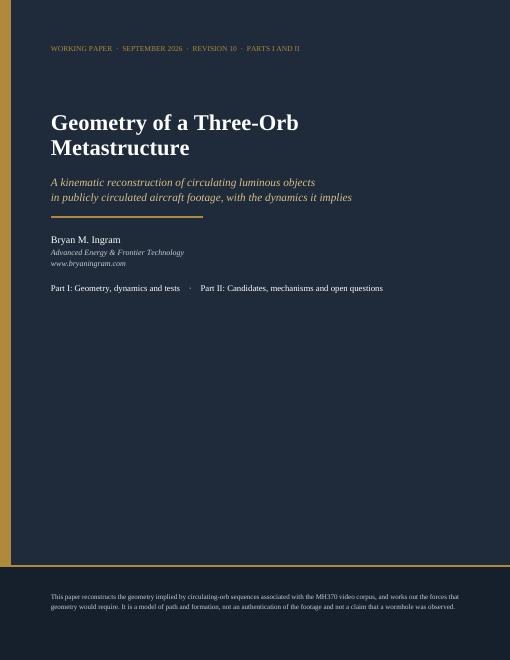
Geometry of a Three-Orb Metastructure
A kinematic reconstruction of the circulating luminous objects in the publicly circulated MH370 video corpus — treating the objects as real point masses and writing down the simplest geometry that fits the reported kinematics: a rigid equilateral triad riding a thin toroidal envelope. Part I derives the geometry, the dynamics it implies, and the measurements that would confirm or break the model; Part II costs the candidate mechanisms against those requirements. Offered as a measurement frame, not proof of exotic propulsion.
Download the paper ↓ Read online Part I Part II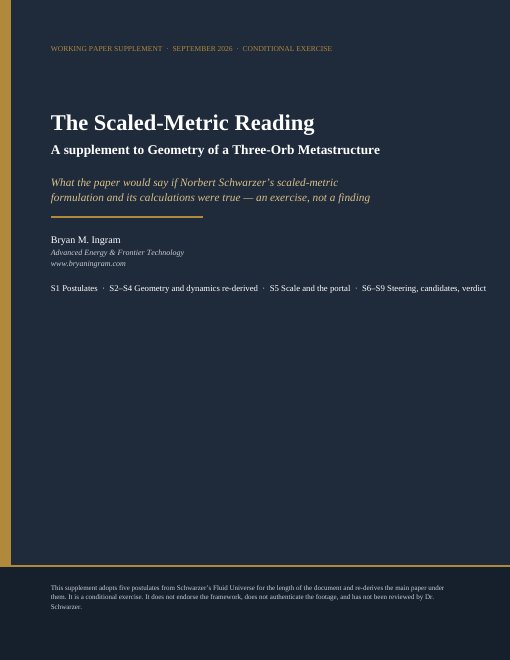
The Scaled-Metric Reading
What Geometry of a Three-Orb Metastructure would say if Norbert Schwarzer’s scaled-metric formulation were true — an exercise, not a finding. Part of the Open TOE Lab.
Download ↓ Read online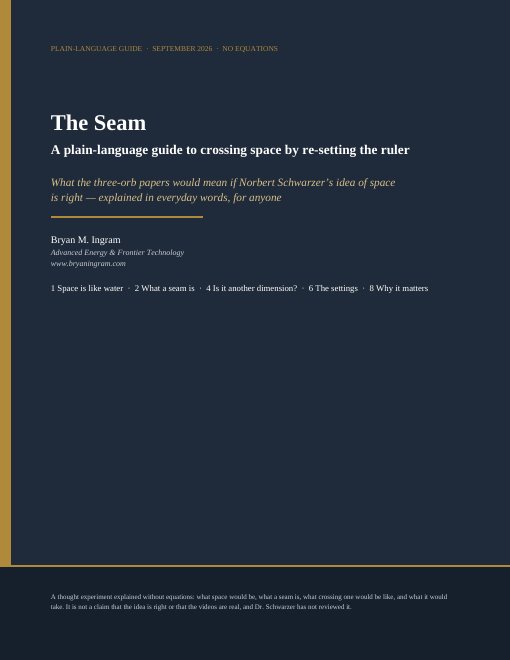
The Seam
The thought experiment in everyday words, with no equations. Part of the Open TOE Lab.
Download ↓ Read online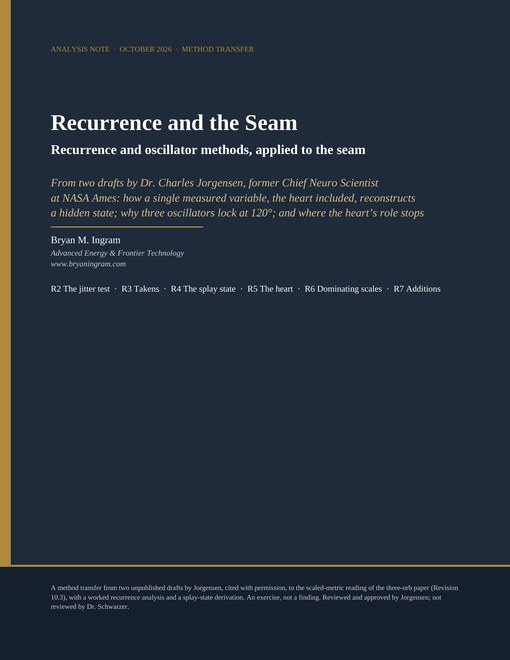
Recurrence and the Seam
An analysis note applying two unpublished drafts by Dr. Charles Jorgensen, former Chief Neuro Scientist at NASA Ames, to the seam: recurrence quantification as a test for the formation, and a splay-state derivation. An exercise, not a finding. 13 pages.
Download ↓ Read online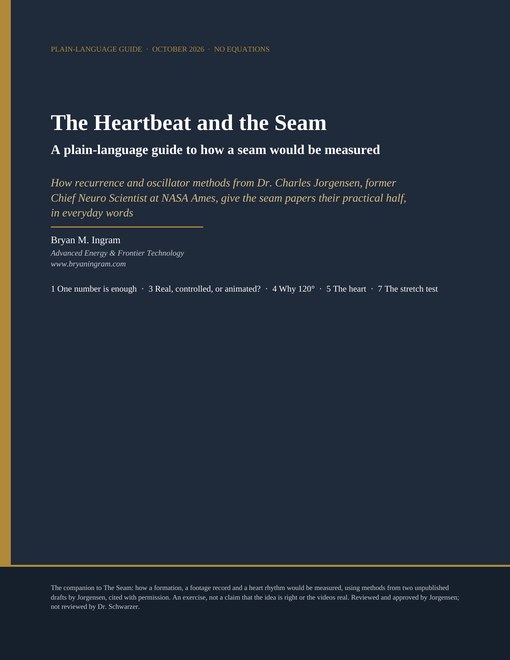
The Heartbeat and the Seam
A plain-language companion to The Seam, with no equations: how a formation, a footage record and a heart rhythm would be measured with methods from Jorgensen’s drafts. 8 pages.
Download ↓ Read online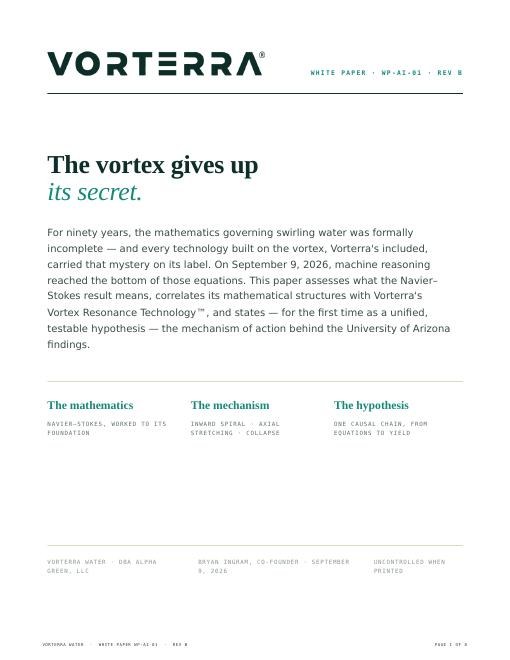
The Vortex Gives Up Its Secret
For ninety years, the mathematics governing swirling water was formally incomplete. In September 2026, machine reasoning reached the bottom of the Navier–Stokes equations — and the two structures in the announcement, the inward spiral and axial stretching, are the two structures a Vorterra unit is machined to produce. This paper correlates the mathematics with Vortex Resonance Technology and states, for the first time as a unified, testable hypothesis, the mechanism behind the University of Arizona yield findings.
Download the paper ↓ Read online